What the product was
An intelligent tutoring platform in real classroom use — educators at Georgia Tech, Rice, The University of Texas and NYU were running it with their students.
That constraint shaped everything. A tutor that guides step by step has to be right about the intermediate steps, not just the final answer.
Working on the ingestion and retrieval pipeline
- Problem
- Course material arrived as handwritten notes, scanned documents, PDFs and video transcripts. None of it was structured enough for the tutor to retrieve or reason over.
- Approach
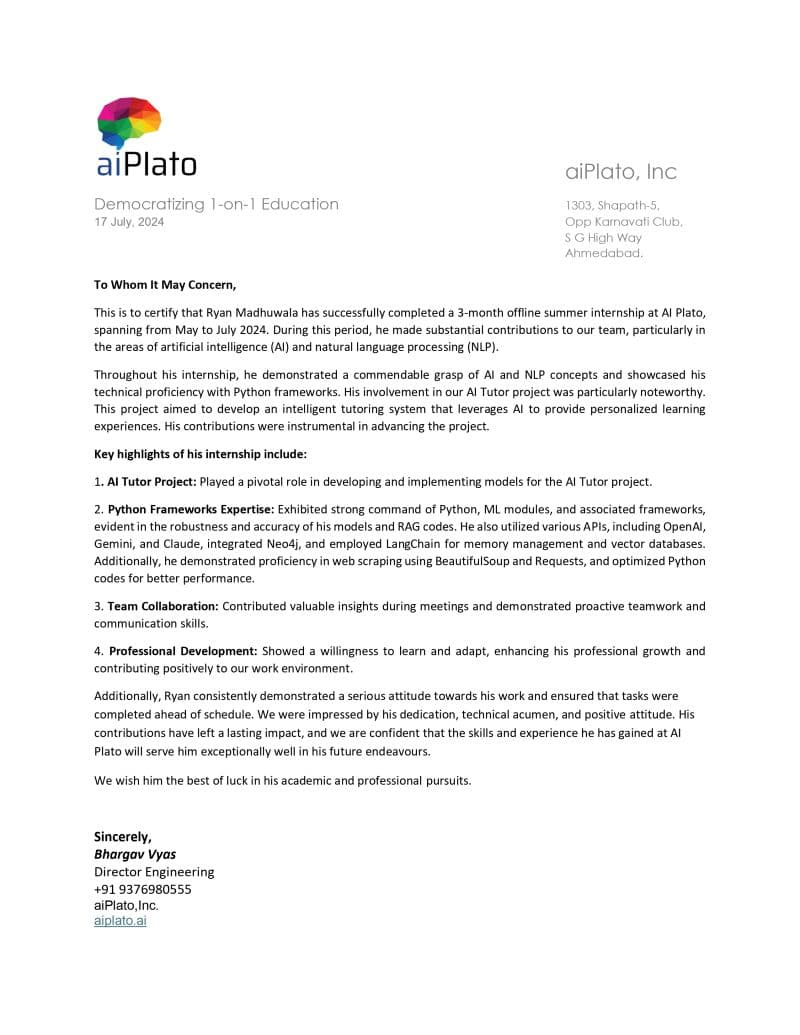
- Worked across the NLP and RAG side of the pipeline: per-format ingestion and cleaning, embeddings into vector search for retrieval, and Neo4j for graph-based knowledge representation, with MongoDB and AWS behind it.
- Result
- Contributed to answer accuracy through data-quality work and model fine-tuning, on a pipeline the production tutor queried directly.
Where my work actually was
Not the model. It was turning a scanned worksheet and a lecture transcript into something worth retrieving, then checking the retrieval had improved.
Retrieval quality is invisible until you measure it. Every gain after I started measuring was larger than everything I had done by intuition before.
What it left me with
My first production codebase, and the foundations — retrieval, vector search, graph representation, fine-tuning, pipeline design — that every project since has been built on.